Half of the deck behind my house was covered in cool shade. A pleasant breeze passed by, temporarily teasing away the summer heat for the moment. Some friends dropped by for a visit. One visitor said, “It feels nice out here.” Everyone agreed, so we all sat down around the deck table. While admiring the yard, another commented, “I see that you have an apple tree in the flowerbed along the driveway.”
I glanced over at the tree and chuckled, “That poor tree has a funny story about how I got it and it has a sad story about what its life has been like in my yard.”
My friends were curious and wanted to know more. So, I told them the funny story first, about how one year I won a gift certificate to a local plant nursery in a “Largest Weed Contest” at the Central Wisconsin Fair. When I was declared the winner, one of the other contestants said I had cheated. My 25-foot wild grapevine aced his gigantic burdock bush. The judge of the contest promised Big Burdock Man that next year the contest rules would outlaw vines. I accepted the certificate as the winner, said “Thank-you” and escaped my fellow contestant’s burning disapproval by quickly disappearing into the surrounding crowd.
“I took my ill begotten gift certificate to the nursery on my next day off from work. I knew what I wanted: an apple tree. Hoping the nursery would have the kind I liked, I checked the tags on all the small saplings. Summer apples didn’t interest me. I wanted an apple that ripens in late fall.
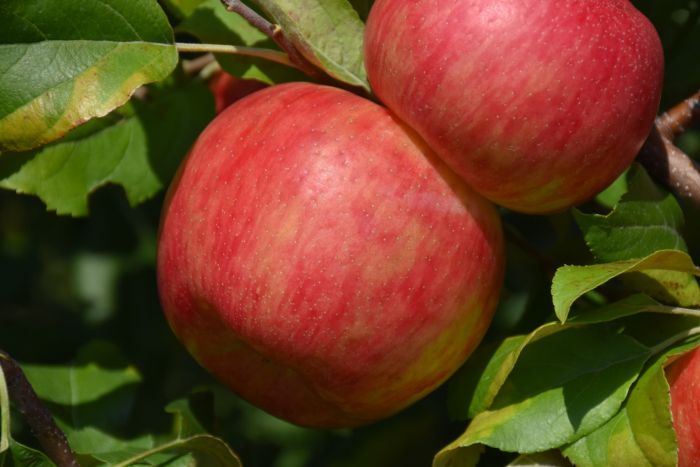
“A sturdy little sapling labeled as a Haralson apple perfectly fit my requirements. Unlike some apples, this apple thrives in a cold climate. It has a firm texture. It’s slightly tart but becomes sweeter after the first frost. Some apples are named for where they came from, others are named for a characteristic. This one is named for one of the men who developed it at the University of Minnesota: Charles Haralson.
“I took that baby tree home and planted it in a flowerbed close to the house. It survived the shock of being transplanted, but from day one, deer came by every night to nibble on the apple tree branches. Quack in the flowerbed around the tree tried to choke it off. Then one morning I discovered a nice, healthy branch on the apple tree broke off. Deer tracks around the tree told me all I needed to know. A nibbling deer must have yanked at the branch hard enough to break it.
“In the following years, deer continued to nibble on the apple tree branches. Just as I was beginning to think the tree branches were getting too big to be snapped off by a deer, it happened again! The damage this time made the tree look lop-sided.
“Despite the repeated damage, the Haralson apple tree grew tall. It began to produce bright red apples that were delicious whether eaten raw or baked in pies. Then, two years ago, it bloomed like I’d never seen it bloom. Every branch and practically every twig was covered with blossoms. I didn’t worry because I figured that Mother Nature would take care of any excess apples. All my life, I’d seen small green apples wither and fall to the ground during the summer.
“That summer every blossom on the tree developed into a beautiful, healthy, heavy apple. I nervously eyed the tree, wondering if I should try to cull the crop and wondered how a person would go about doing that.
“Before the apples could become completely ripe, one night during a rainstorm, the large, main branch broke. The following spring, what was left of the traumatized tree, didn’t send out a single blossom. This year, it blossomed modestly and has a few apples on it.”
One visitor exclaimed, “What an unlucky tree!” she teased, “Maybe Big Burdock Man put a curse on it because you won and he didn’t.”

