Archive | April 2026

Spring Came Anyway

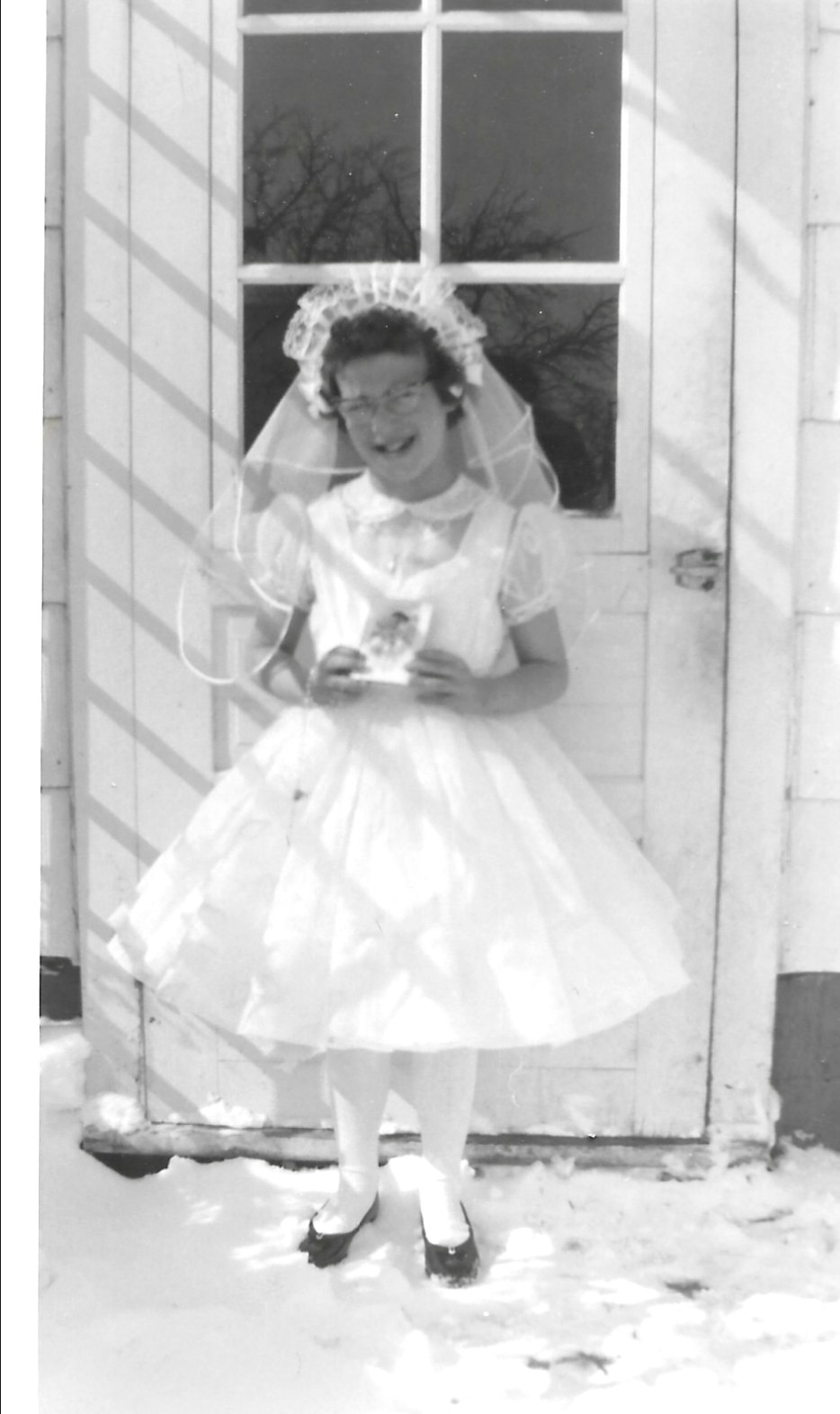
The snow had melted, but the early April days remained overcast and dreary. In my brightly lit second-grade classroom Sister Michaeleen worked hard to prepare her large class of children to make their first confession and receive First Communion. There were prayers to remember, devout actions to memorize for a lifetime and a schedule to complete our preparations.

            For the Sunday on which we attended our First Communion, many of my classmates would wear an all-white dress and veil an older sibling had worn a year or two before for their own First Communion. A few classmates were getting a new white dress and veil. Every girl in class was atwitter with excitement. The boys just shrugged when they were told to attend First Communion Mass wearing dark pants, a white shirt and tie. Their mothers would take care of those details.

            “Now girls,” Sister Michaeleen reminded, “Be sure to wear your whitest stockings with your Communion dresses.” I looked down at the baggy, wrinkled tan stocking on my legs, and then across the aisle at Violet, a pretty girl who lived in town. She always wore white stockings.

            I hated how the tan stockings looked. It seemed to me that only girls who lived on farms wore tan ones. Tan or white, these stockings were held up with garter clips just above the knees. I had once told my mother that Sister Michaeleen wanted all the girls in class to wear white stockings every day. There was no fooling Mom with my ‘white’ lie. I was her seventh child.

            When recess bell rang, Sister sent us out into the parking lot playground next to the school with the instruction, “Practice your prayers!” My classmates and I paired off in groups and walked back and forth on the dirty blacktop under a glowering gray sky. Arm in arm we practiced saying our First Confession prayers, “Bless me Father for I have sinned.” Our First Communion would be soon, but I was a little hazy about when exactly.

That afternoon it started to snow shortly before Daddy picked us up from school. Snow and a sharp blast of wind entered the car before I could slam the door shut. Mom had come into town with him to buy a few groceries. She pulled her coat up closer to her neck saying with a shudder, “The forecast says this storm is going to be a blizzard.”

From my snug spot between Mom and Daddy in the front seat of the car, I asked, “But it’s April, aren’t we going to have spring? Sister said, ’April showers bring May flowers’!”

Heavy snow and wind made it hard to see the barn from the house by evening when  the milking chores needed to be done. In the morning, Daddy didn’t drive us kids into school because it had been called off due to the inclement weather. I overheard Mom and Daddy talking about not being able to go into town for something the following day.

Continue reading

OCD Me

Lifting a gallon of milk off the grocery store’s refrigerator shelf, I turned to put it in my cart when I came face-to-face with a nurse that I had worked with a few days before. Rosie had a toddler with her and a baby sitting in her shopping cart. Delighted to see her, and for a chance to introduce her to my daughter, Tammie, I glanced at my grade school daughter and said, “Tammie, this is the nurse I told you about. Rosie, this is my daughter, Tammie.”

They shook hands. We had a lovely visit, but soon went our separate ways as Rosie’s baby began to fuss. Rosie and Tammie were both born with TAR syndrome, causing them both to have elbow-length arms. Tammie’s hands sharply angled in, while Rosie’s did not.

On our way home from the grocery store, Tammie had many questions. The first, “Why are her hands so different than mine?” I explained that some people with TAR syndrome have surgery on their hands to ‘centralize’ them, which I suspect gives them a farther reach.

I began to tell Tammie that Rosie had seven siblings and that she had one sister who also had TAR. She and her sister never needed blood transfusions, nor surgeries to correct lower extremity deformities. My daughter wondered, “How can that be for someone with TAR?”

My explanation that evening became an often-repeated maxim, “All illnesses, syndromes and tendencies are experienced by people on a one to ten scale.” I tried to explain that what one person experiences with an illness or disability isn’t what everyone experiences.

In my mind, Rosie and her sister had TAR on the scale of maybe three or four. Tammie with all her blood transfusions and leg surgeries, had TAR on the scale of about six or seven. We also knew a boy with TAR who had hands coming out of his shoulders and was never able to walk independently. For those extra challenges I felt his experience of TAR had to be at least a nine on the scale of ten.

Continue reading