I wanted to find some shade. The fall sunshine shone as brightly as light refracted through a magnifying glass. The bus we’d just exited pulled away from the bus stop. Hot-smelling fumes coming from the vehicle’s exhaust pipe made me turn away from it and cough. My daughter Tammie said, “The map said it’s just a ten-minute walk from here.”
Ten minutes later, there seemed to be no end to the street ahead of us. I complained, “When maps say things like, ‘It’s an easy walk,’ they aren’t talking about people with a walking disability. We walk too slowly and frequently stop to rest for that estimate to be correct.”
Tammie ignored my rant and stated, “It isn’t much further. We’re looking for a gate.” She was right; at the street’s end was a gate to a park. Walking through the gate, I glanced around at the trees, lawns, and paths before questioning, “I thought you said we were visiting Nero’s palace today.”
My daughter confirmed, “We are. It’s his Domus Aurea, which means golden house. The subsequent emperors and his subjects hated Nero so much that after he killed himself, they stripped the house of valuables and buried the building.”
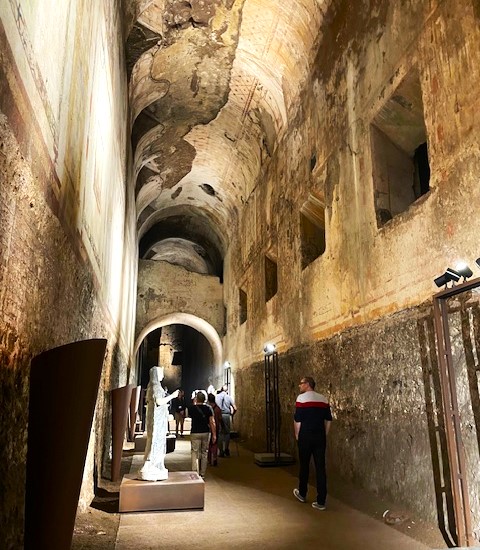
To my surprise, we had to descend several flights of stairs to reach the huge, excavated dwelling. I murmured to Tammie, “The people must have really, really hated Nero! Burying a place this big, even with modern-day backhoes and scoop shovels, would be a huge job. Back in the first century AD, all they had were buckets and baskets! What did he do to be so despised?”
Since there were other people touring the underground archeological site, Tammie whispered her answer, “Nero was ruthless and cruel. It was suspected that he had an incestuous relationship with his mother. He married three times, once to his stepsister. He killed his pregnant second wife in a fit of anger by kicking her in the belly. His third wife was a married women whose husband Nero had killed. People in Rome suspected he set the fire that burned most of Rome in 64 A.D. because he wanted to build a new palace. When his palace, Domus Transitoria on the Palatine hill burned in the fire, he began to build here.”
Stepping into an open gallery, we caught up with the tour group we had been rushing to join. The guide spoke with a strong Italian accent. She explained, “To build his Domus Aurea, Nero squandered the Roman treasury and heavily taxed the citizens of Rome. This palace was named the Golden House because of the huge amount of gold leaf and jewels used to decorate it.”
The rooms had high vaulted ceilings and despite the many years that had passed since the frescoed walls and ceilings were decorated, the designs were still beautiful. Looking up, I marveled once again at the extreme effort it would take for first century workers to not only fill in but cover a building this large.
In a large palace hallway, our guide pointed out windows high on the outer wall. Across from them on the inner wall, but lower, were windows. The guide said, “These windows were perfectly lined up in a way to allow sunshine to reach the inner rooms of this building.”
There were 300 rooms in Nero’s Domus Aurea which, included a rotating dining room. The grounds around his palace had manicured gardens, a private bath complex and an artificial lake. Nero was so vain; he had a 120 foot statue of himself placed in the palace entry vestibule.”
After the tour was over, Tammie and I sat on a bench under an olive tree to rest. The colosseum was just down the hill from us, and I remembered the tour guide saying that it had been built where Nero’s man-made lake had been. My daughter pointed out, “Nero was only 16 years old in 54 AD when he became the Emperor. He reigned for 14 years until his suicide in 68 AD.”
Leaning back to look up into the olive tree branches above us, I admitted, “That this large building was buried by people who hated Nero after he died is the one fact that made the biggest impact on me today. That shows a tremendous amount of hate. I wonder how long it took them?”
An olive fell from the tree next to us and landed with a plop. Tammie said, “Near the entrance there was a sign that said it took about 40 years.”
Curious to learn more about this controversial emperor, I researched his history upon my return home. Nero’s full name was Lucius Domitus Ahenobarbus. He took the name Nero, at age 13 when he was adopted by his great uncle Emperor Claudius. Even by the standards of the time, Nero’s debauchery and cruelty was extraordinary. He eventually had his mother killed and did many other horrible things, like having Christians covered with tar and set on fire to entertain the guests at a dinner party.
 Life Lines
iNTERESTING STORY!