Roasting Chestnuts

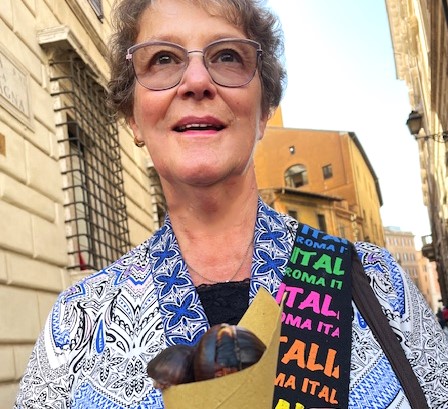
The chestnut shells looked charred from the grill.

My daughter brightly chirped, “The outdoor market we’re visiting is just a short walk from here.”

I chuckled. I’d heard Tammie say, ‘It’s just a short walk from here’ every day, sometimes several times each day, since we’d arrived in Rome a week and a half earlier. She especially liked to share this information within moments of stepping out of a bus or subway car to reassure me we wouldn’t be walking a long distance. Often, the two blocks felt like miles to me.

Each small shop called to me as we passed, “Stop and shop!” I was drawn to a leather purse, a table runner, and a bottle of Limoncello. Although I’d shopped every day for the last ten days, everything looked fresh and interesting as though I was seeing it all for the first time. Tammie laughed at my enthusiasm. I grimaced and admitted, “You know what’s going on, here, don’t you? We’re flying home tomorrow, and this is our last day of vacation.” Pausing, I continued solemnly, “One summer day when your grandma had terminal cancer, she shared with me that the sky had never looked bluer, and the tree leaves never looked more vibrantly green to her.”

My daughter nodded in understanding of my analogy and added, “Knowing she’d never experience another summer, she wasn’t taking anything for granted.”

The narrow Italian street we were walking, came to a large open, cobblestoned, oblong piazza, filled with water fountains, statues, and crowds of people. Tammie asked, “Do you remember this place?”

Amazed, I looked around and exclaimed, “We visited this place on our second day in Rome, but we entered from the side furthest from where we are now.”

Pointing to a side street, Tammie announced, “The open market is one block away. I can see some sales booths from here.”
Continue reading

44 B.C. Crime Scene

Crime scene In Italy, over two thousand years after the crime.

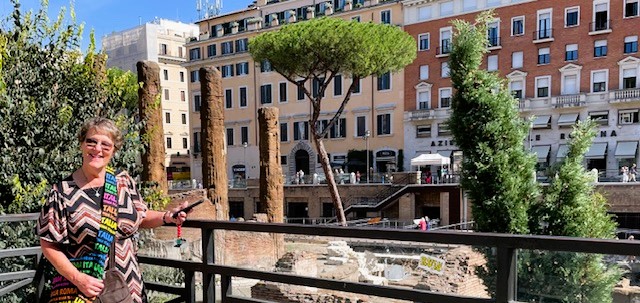
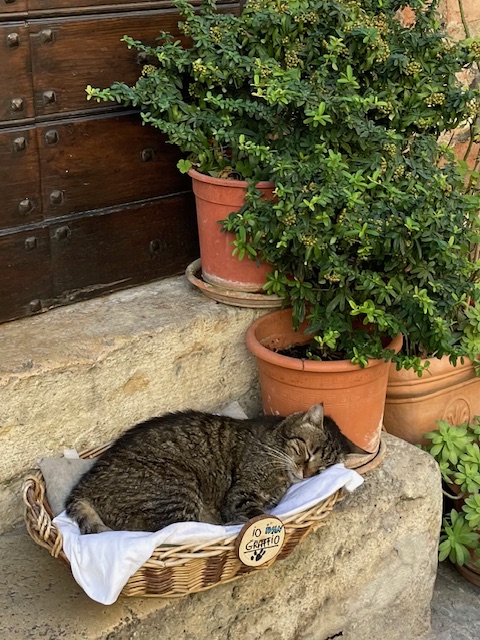
I looked forward to seeing the spot where Brutus killed Julius Caesar, but every time my daughter Tammie and I talked about going there, she kept talking about, “Santuario dei Gatti di Torre Argentina” which could be found at the same location. “It’s a cat sanctuary,” she excitedly informed me. I had the distinct impression she was more interested in seeing the cats than seeing the famous Emperor’s historical murder site. The incongruity of the two sites sharing the same space was lost on me.

My interest focused more on the 2,067-year-old crime scene. Not knowing what it would look like all these years later, I wondered with a chuckle, “Would there be a large ‘X’ marking the spot where it happened, and yellow tape cordoning off the area?”

When we arrived at Largo di Torre Argentina (Tower Square), the place managed to surprise me. It was a large open space the size of a city block, surrounded on all four sides by tall, solid buildings, some of which were ornately decorated. Within the walled-in block there were many ancient pillars and paving stones below street level, which dated back to the Curia of Pompey, the Roman senate building, the very spot where Caesar is believed to have been assassinated. Also contained within that block were the remains of four Roman temples built there in the centuries following the crime.

Continue reading

Reaching New Heights

The outskirts of Rome fell behind us as our bus merged onto a busy highway north of the city. I leaned forward to peer out of the window, eager to see what the Italian countryside looked like. For the last seven days, my daughter Tammie and I had been exploring the city of Rome. Today we were leaving ‘The City of Seven Hills’ in the Lazio region, to visit Orvieto and Assisi in the Umbria region and to stop for lunch in the Tuscany region.

Rows of pale green olive trees marching alongside the road flashed by. Vineyards with vines pruned to increase production, dusty tobacco fields, hay fields and harvested grain fields dotted the countryside. Clumps of extremely tall pampas grass, and an Italian high speed train shooting through the countryside fascinated Tammie and me.  Driveways to farmhouses that were lined with Italian balloon pine trees or palms made us want to stop to investigate. Mountainous ridges formed our horizon to the left and right. The highway appeared to be on a flat plain between them.

The medieval town of Orvieto was our first stop. Our bus drove uphill as far as the road went. Getting off the bus, we entered a vehicle called a funicular, which is a cable railway system used on steep slopes. Funicular systems have two counterbalanced carriages called cars or trains. They are permanently attached to both ends of a haulage cable, which results in the two cars moving in opposite directions at the same time. As one goes down, the other goes up. The unusual name, funicular, is from the Latin word for rope (cable). 

Getting off the funicular, we hadn’t reached the city of Orvieto, yet. There were still two flights of stairs to climb. I wished the funicular had continued up this slope. As I ascended, I counted each step, and the grand total was 48. Our guide explained that medieval towns were built on hilltops because enemies were unable to launch surprise attacks on them and the towns were more easily able to defend themselves.

Continue reading

Hidden Beauty

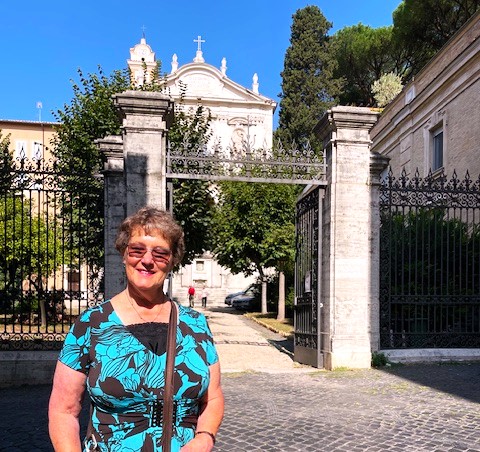
Sunny Sunday morning in front of San’t Isidoro in Rome.

I rinsed dish soap off a plate and placed it in the rack. Turning to where my daughter Tammie was sitting at the table, I asked, “Can you find an English Mass celebrated, here in Rome? An Italian one would be all right, but I would prefer understanding the words of each prayer.”

Looking up from her phone screen, Tammie announced, “I just found one. It’s called Chiesa di San’t Isidoro. Since it’s close to the Trevi Fountain and the Spanish Steps, would you like to spend the afternoon visiting those places?”

On Sunday morning, we got up early to allow travel time. We didn’t have to wait very long in the shade of a lovely small tree for the bus to come. The large, lumbering vehicle was full. Shortly after we boarded, most of the passengers behind us began to sing a song in French. I turned and noted that our impromptu choir consisted of a jolly-faced, zucchetto-wearing Bishop and several of his collar-wearing seminarians. They got off the bus before Tammie and I did.

Pointing to a shaded street that curved around several large buildings, Tammie explained, “Even though the street curves, we’re to walk straight up that hill to the end of the block. Then we should be able to see the church.”

We walked past several sidewalk cafes that hadn’t opened yet due to the early hour. The huge shade trees along the way had unusual, gray, smooth trunks, and large leaves. Looming up in front of us was a very steep, long flight of stairs. Reaching the top, we saw a lawn enclosed within a fence and a dirt driveway. Beyond it, further up the hill, was the church we were looking for. Several cats were roaming around the yard and sitting in boxes under shaggy evergreen bushes.

Continue reading

Nero’s Pleasure Palace

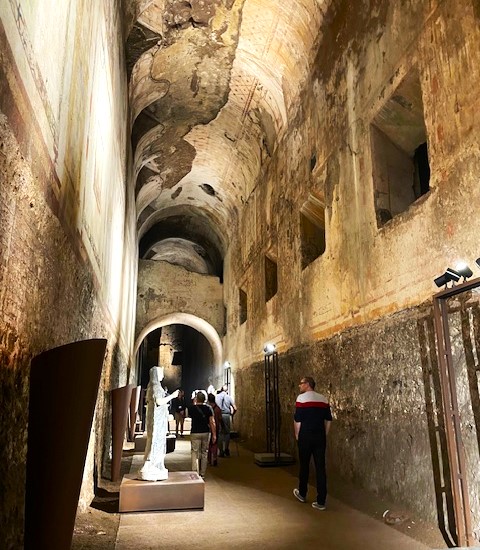
Hallway in Nero’s Pleasure Palace.

I wanted to find some shade. The fall sunshine shone as brightly as light refracted through a magnifying glass. The bus we’d just exited pulled away from the bus stop. Hot-smelling fumes coming from the vehicle’s exhaust pipe made me turn away from it and cough. My daughter Tammie said, “The map said it’s just a ten-minute walk from here.”

Ten minutes later, there seemed to be no end to the street ahead of us. I complained, “When maps say things like, ‘It’s an easy walk,’ they aren’t talking about people with a walking disability. We walk too slowly and frequently stop to rest for that estimate to be correct.”

Tammie ignored my rant and stated, “It isn’t much further. We’re looking for a gate.” She was right; at the street’s end was a gate to a park. Walking through the gate, I glanced around at the trees, lawns, and paths before questioning, “I thought you said we were visiting Nero’s palace today.”

My daughter confirmed, “We are. It’s his Domus Aurea, which means golden house. The subsequent emperors and his subjects hated Nero so much that after he killed himself, they stripped the house of valuables and buried the building.”

To my surprise, we had to descend several flights of stairs to reach the huge, excavated dwelling. I murmured to Tammie, “The people must have really, really hated Nero! Burying a place this big, even with modern-day backhoes and scoop shovels, would be a huge job. Back in the first century AD, all they had were buckets and baskets! What did he do to be so despised?”

Continue reading

Cooking with Wine

The bus moved along quickly, despite Rome’s busy and sometimes winding, narrow streets. The cooking class Tammie and I had signed up for was several blocks from our Airbnb apartment. After riding for what seemed to me a long time, my daughter finally turned to me and nodded. Our stop was coming up.

Even before the bus lurched to a stop, we were on our feet moving toward the exit, clutching the handrails. When the bus pulled away a moment later, I looked around and asked, “Where is this cooking school we’re going to?” Tammie studied the instructions on her phone and motioned toward the end of the street, saying, “We have to walk a block or two.”

Hot, late afternoon sunshine beat down mercilessly on us as we approached a shaded street corner. Next to it was a large, multi-street intersection. My daughter urged, “Come on, Mom. We need to cross here, now. The traffic light is in our favor.” A tall cement wall on the other side of the street looked like it was holding back one of Rome’s famous seven hills. In the wall was an opening, and as we approached, I realized that it was a steep stairway with weeds growing out of cracks.

At the top of the stairs, we found an unremarkable city street lined with dingy buildings. Two men were leaning against the top of the wall smoking cigarettes. One of them motioned toward the first doorway and informed us, “If you’re here for the class, go right in.” I glanced around, looking for a sign or some other way that would indicate we were in the right place. Seeing none, I felt uneasy and unsure of myself.

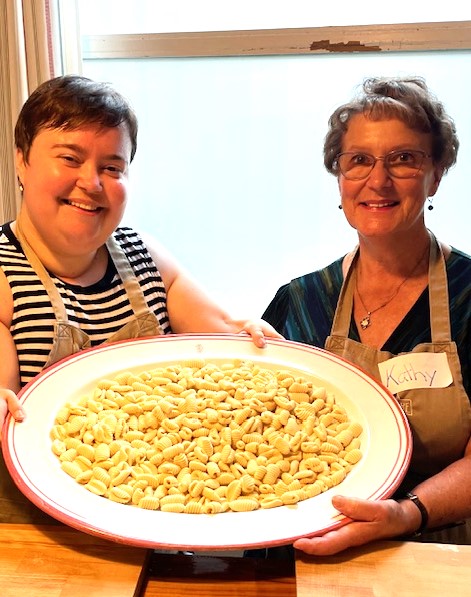
Opening the door, I was surprised to find myself in a large, well-equipped kitchen. A man greeted us and escorted us past a dining room with a long table set for a dinner party to a small living room. There were six people already there sipping wine and making small talk. Our guide disappeared as introductions revealed one couple was from Chicago and the other two couples were from Newfoundland. The man returned and handed Tammie and me glasses of white, sparking wine. He noted that it was, “Prosecco.”

Continue reading

King’s X

Barb chased Alice around, back, and forth through the yard. Donna zig-zagged across the lawn to get out of the way, while I did the same thing in the opposite direction. Our game of tag had one rule: we had to stay in the yard. That wasn’t a problem. The yard was large. My three neighborhood cousins and I had plenty of room to move around. Our shrill screams cut through the still yard. Bats living in the orchard woke up and swooped through the darkening sky above to devour mosquitoes. A firefly slowly blinked its way across the lawn. I shuffled my feet through the dewy grass, enjoying how cool it felt. The day had been uncomfortably hot.

Alice unexpectedly changed direction and picked up speed. Donna happened to be in the wrong place at the wrong time. Since this sister would be an easier tag victim, Barb reached out to touch her. Donna evaded her by dropping to the cool, damp grass and rolling out of reach. Stopping in her tracks, Barb called out, “Tag! You’re it!”

Jumping to her feet, Donna hotly replied, “I am not! You missed touching me.”

Barb shouted, “I did too, touch you! I felt your hair with my fingers just as you moved away.”

Alice jumped into the argument with, “Touching hair doesn’t count.”

Bemused, I listened to my cousins argue. There were seven children in my family, but my siblings were all five and a half to fifteen years older than me, causing me at times to feel like an only child. We never had shouting-match fights. My cousins came from a family of seven children as well, and these three were all one year apart.

Continue reading

Away in a Manger

Sister Florence looked ancient. All we could see of her body were her hands and face, since everything else was covered with her flowing robe, starched wimple and veil. Her hands and face were very wrinkled. Sister Florence seemed especially old, because in the last few years, most of the new sisters assigned to our school convent were very young. Sister Donna, my first-grade teacher, looked no older than my sister who had just graduated from college.

Sister Florence’s advanced age prompted my third-grade class to speculate on whether she would possibly retire soon. By the beginning of November, it appeared that all the scary stories and rumors about Sister weren’t true. She wasn’t mean, wasn’t on the verge of having a nervous breakdown, nor likely to drop dead from old age during classes.

Sister Florence turned out to be kind. When we had our first snowfall that year, we were excited and couldn’t concentrate. She sighed but then instructed, “All of you go stand by the windows for a few minutes to watch the falling snow. When you sit back down, I want your full attention.”

Another example of her kindness occurred while a new convent for the sisters was being built next to our school that year. When the construction crew lifted the cross to its roof with a crane, she told us to watch, saying, “You’ll remember this all your life.”

On the last day of November, my class and I entered the classroom after recess to discover small, open-topped boxes with our names on them lined up on a blackboard eraser shelf. Hushing our whispering, Sister Florence unnecessarily explained, “Christmas is coming.”  

Continue reading

Mary’s Christmas

Mary smiled when I walked into her room at the Stoney River Assisted Living Facility. She exclaimed, “My sweet little baby sister!” I laughed and kissed her cheek. She had often called me that when we were growing up in our childhood home.

Holding out a small vase filled with lovely red and yellow tea rose blossoms for her to see, I marveled, “Despite the cold nights this past week, the rose bushes in my garden are blossoming. All the plastic walls of the greenhouse do is block the wind, but that must be enough to allow some healthy plants to thrive this late into fall.”

My sister lightly touched a blossom and observed, “They’re pretty.”

Placing my flowers on the dresser across from her bed, I commented, “It’s hard to believe that Christmas is just a little over two months from now! As a little girl, I loved when you told me your memories of moving into the new farmhouse two days after Christmas the year before I was born.”

Mary nodded and explained, “Daddy said the varnish on the woodwork wasn’t dry until then. A bed sheet was wrapped around the Christmas tree, and it was carried across the snowy yard to our new house. Only one ornament fell and broke.”

Continue reading

Choosing What to Remember

Sitting at the dining table at our Airbnb apartment in Rome, I took a sip of hot tea and commented, “You won’t be able to top what we experienced yesterday!”

Chuckling, my daughter took a nibble of a Nutella cookie and admitted, “That’s true! How could anything top our meeting Pope Francis and shaking his hand?”

Spreading strawberry jelly on a cracker, I confessed, “While waiting for our turn to meet the Pope, I kept thinking about the nursery rhyme that goes, ‘Pussycat, pussycat, where have you been? I’ve been down to London to see the Queen. Pussycat, pussycat, what did you there? I scared a mouse under her chair’. Only for us, the rhyme would go, ‘Pussycat, pussycat, where have you been? I’ve been down to Rome to see the Pope. Pussycat, Pussycat, what did you there? I shook the hand of the Pope, with excitement hard to bear.’”

Blowing on her tea to cool it, Tammie agreed, “We were lucky little pussycats to have that experience yesterday! Our visiting the Vatican Museum and the Sistine Chapel today won’t be as exciting, but I’m looking forward to it.” Proud to have planned so well, Tammie bragged, “We won’t have to stand in long lines. The tour will allow us to go, see, and leave. I’m also hoping to be the first tourists of the day to visit the Sistine Chapel and it won’t be crowded.”

Continue reading