The dining room waiter pulled out my chair and then deftly slid it in as I sat down. I smiled at him as he opened my cloth napkin and laid it on my lap. Such respectful, formal treatment by everyone working in the main cruise ship dining room made me look forward to returning there for all my meals. Besides the sterling service, the food we ordered was, without exception, well prepared and attractively presented.
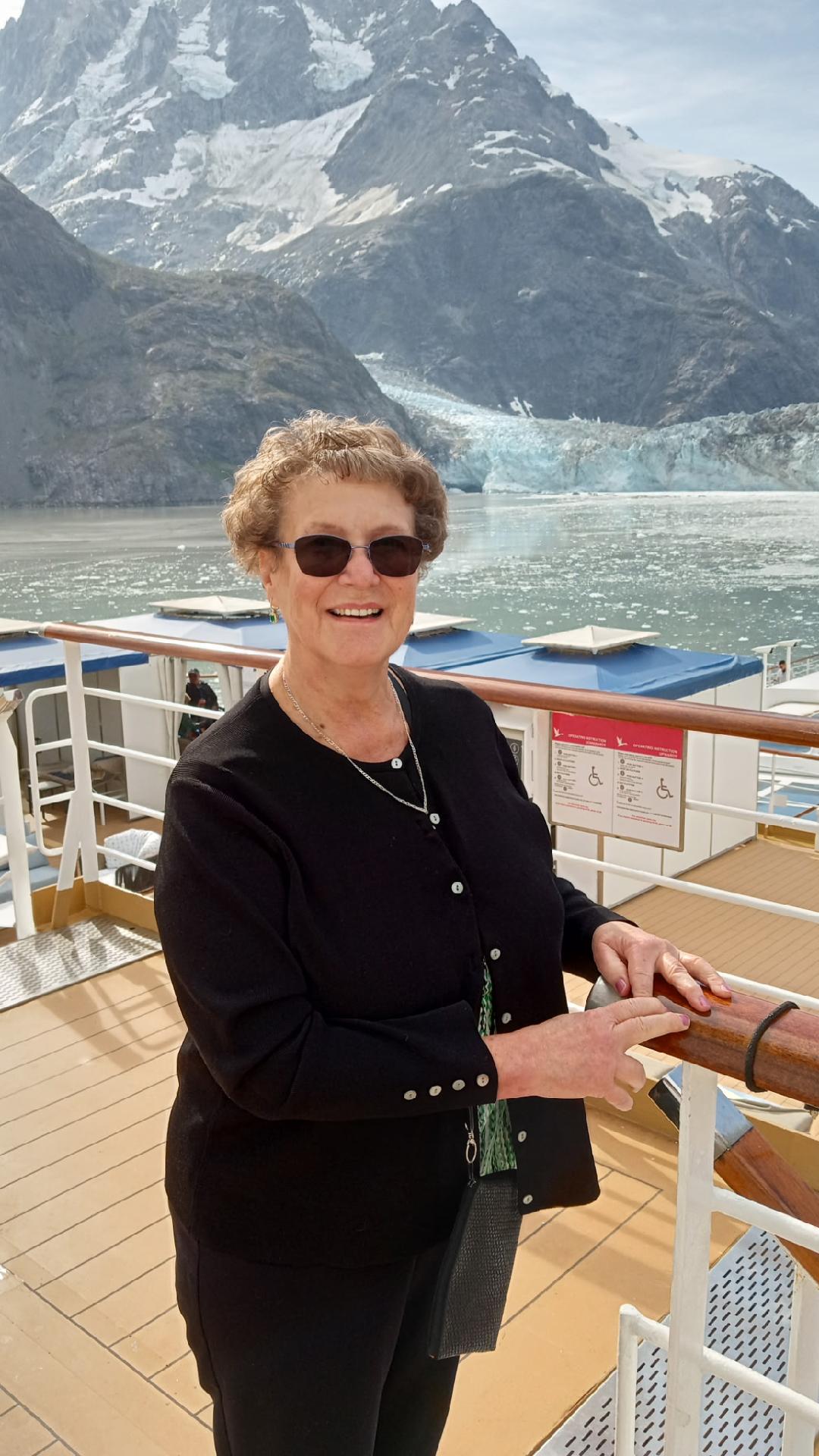
This morning, we shared our table with fellow travelers, Pat and Lorin. Our conversation centered on how many cruises we’d been on and about the park rangers who were giving talks on the Alaskan wildlife which was to take place in the Crow’s Nest Lounge. The main activity for the day was seeing a glacier close-up. Our cruise ship was to approach within half a mile of the face of the Johns Hopkins Glacier, in the Glacier Bay National Park and Preserve.
Upon parting from our dining room friends, Tammie and I hurried up to the Crow’s Nest Lounge on deck eleven. Good fortune allowed us to almost immediately find recently vacated deck loungers along the observation windows. The ship was moving slowly now, and tall, rocky land rose up on each side of us. In the distance, we could see snow-covered mountain tops.
The lounge was very large and curved, so I couldn’t see where the ranger was, but he had a microphone so everyone could hear. He explained that Harry Fielding Reid, who discovered this glacier in 1893, named it Johns Hopkins after the university in Baltimore, Maryland. The ranger continued, “The Johns Hopkins Glacier is one of the few advancing tidewater glaciers of the Fairweather Range. Starting on the eastern slopes of Lituya Mountain and Mount Salisbury, it is12 miles long. The face of this glacier is one and a half miles wide.”
Looking down eleven stories from the lounge window at the water in front of the ship, I exclaimed, “Look, Tammie! There are small chunks of ice in the water!” The ranger was saying, “For ice to become a glacier, it needs to be so large and dense that it moves under its own weight. The ice starts out as snow that builds up and builds up. Seasonal thaw and melt compact it into a dense mass.” As we proceeded deeper into the inlet leading to the glacier, ice chunks surrounding the ship became more numerous and larger.
A long way ahead of us, I could see the glacier. The ranger continued, “Glaciers produce what some people call rock, or glacial flour. This is fine-grained silt made when a glacier picks up rocks and as the ice advances, then those rocks grind across the bedrock beneath. When this silt gets into the glacial fjord, it becomes suspended, making the water appear cloudy, which some people call glacial milk.”
Up ahead, the face of the Johns Hopkins Glacier didn’t look a mile and a half wide to me, until I realized that a vast part of the right side of the face had a huge amount of silt mixed in the ice, making it look like a brown cliff. The ranger informed us, “There are 198,000 glaciers in the world. The largest is the Lambert Fisher Glacier in Antarctica. It covers 250 miles. The second largest is the Hubbard Glacier in Alaska, which is also a tidewater glacier and is also still advancing.”
Glancing at my daughter, I quietly marveled, “I had no idea there were so many glaciers in this world!” We were now very close to the face of the glacier. Thousands of ice floes bobbed in the water at the foot of the ice. The park ranger pointed out, “Look closely at the ice floes. You will see small black dots on them. If you use your binoculars, you will discover those dots turn out to be little sausage-shaped seals. Fish and krill are abundant near a glacier, which the seals need to successfully pup and nurse. The floes provide a stable place for seals to rest and breed.” Just then, a large chunk of ice fell off the face of the glacier and made a big splash. Everyone in the lounge cheered as though they’d witnessed a touch-down.
Suggesting that we go out on the open deck of the ship, the ranger explained, “If you’re lucky, you’ll see and hear the glacier calving. Calving is what we call ice breaking off the face of a tidewater glacier.”
Tammie and I took turns going outside on the deck so that we didn’t lose our prime seats in the lounge. That day was mild with bright sunshine and very little wind, so I was comfortable in a light sweater. I’ve seen glaciers calving on television but never appreciated the sound that goes with such an event. I heard a loud crack, then a long thunderous rumble, followed by a splash. There were several calving’s during the hour the ship paused for the passengers to enjoy seeing such an amazing sight. Some of the calving’s were very small. Others were much larger, making all the nearby ice floes rock and bob.
That evening Tammie and I talked about the amazing experience. I couldn’t resist joking, “Holy cow! I saw up close a glacier calving. The baby must have weighed several tons! It had better be a girl, because I’m calling the calf, Florence. We can call her Floe for short.”
Tammie laughed and then teased, “Holy cow, are you full of it tonight! That sounds like a dad joke.”
Grinning, I admitted, “I am trying to channel Arnie. He would have loved this cruise.”
 Life Lines