In the distance, I could see what looked like a small village on the shore. I stated rhetorically, “That can’t be Juneau. It looks too small to be Alaska’s state capital!”
My daughter studied the buildings and the dock, which our ship, the Eurodam, was approaching. Before she could say anything, an overhead announcement began, “Good afternoon, ladies and gentlemen, this is your cruise director…” He told us the dock we were approaching was to our right. While to our left, was Douglas Island. Explaining that Juneau has no highways or railroad tracks connecting it with the rest of the country, the cruise director quipped, “The only way to visit Juneau is to travel there by ship, airplane, or birth canal.”
Although Douglas Island is separated from the mainland by the Gastineau Channel, it is a part of the city of Juneau. A bridge over the channel connects the two very different residential neighborhoods and business districts. Tammie, who was standing with me at one of the ships starboard windows, commented, “I think we are just seeing the original part of Juneau. The coastline curves, we just can’t see the rest of the city from here.”
Effectively making her point, an airplane flew over the ship we were on. We watched it bank to the right over the Gastineau Channel and disappear behind the mountain that rose up beyond the Juneau docks. With all the mountainous Alaskan land that I could see from the ship, I wondered where there was land flat enough for an airport landing strip.
Alaska fascinates me. Why is Juneau the capital of Alaska? The most recent census count shows Juneau, which has limited access options, has a population of 32,255 people. While on the other hand, the Alaskan city of Anchorage, which is 507 miles north of Juneau, is connected to the lower 48 states by highways and rail roads. With a population of 291,247 people, it is the largest Alaskan city. Even land locked Fairbanks, 470 miles east of Anchorage, with a population of 31,551, has highways and railroads leading to and from it.
The answer to my question is very simple. When Alaska became a territory of the United States in 1906, Juneau was the largest, most successful city. When the territory became the 49th state in 1959, Juneau was still the largest and most successful city. This was the area where people found gold and became rich! At that point in history, the city of Anchorage was still small and certainly not the hub it is now.
Juneau’s state senator Jesse Kiehl points out that many visitors ask why Juneau is the capital. Many native Alaskans apparently ask the same question. There have been five attempts to move the capital to Anchorage since 1974. He claims the issue, “Is a little bit like a zombie movie. It’s never all the way dead. You can count on it to come back smelly and shambling and (it remains) a problem.”
So many people wonder, “Why don’t they just move the capital to Anchorage?” For convenience, many state jobs are already conducted in Anchorage. Some people call this, “Capital Creep.” Officially, there may never be a move. Senator Kiehl says, “Oh, good Lord in heaven, the price tag! I have no idea what that price tag would be…hundreds and hundreds of millions of dollars at least. And that’s probably a low-ball estimate!”
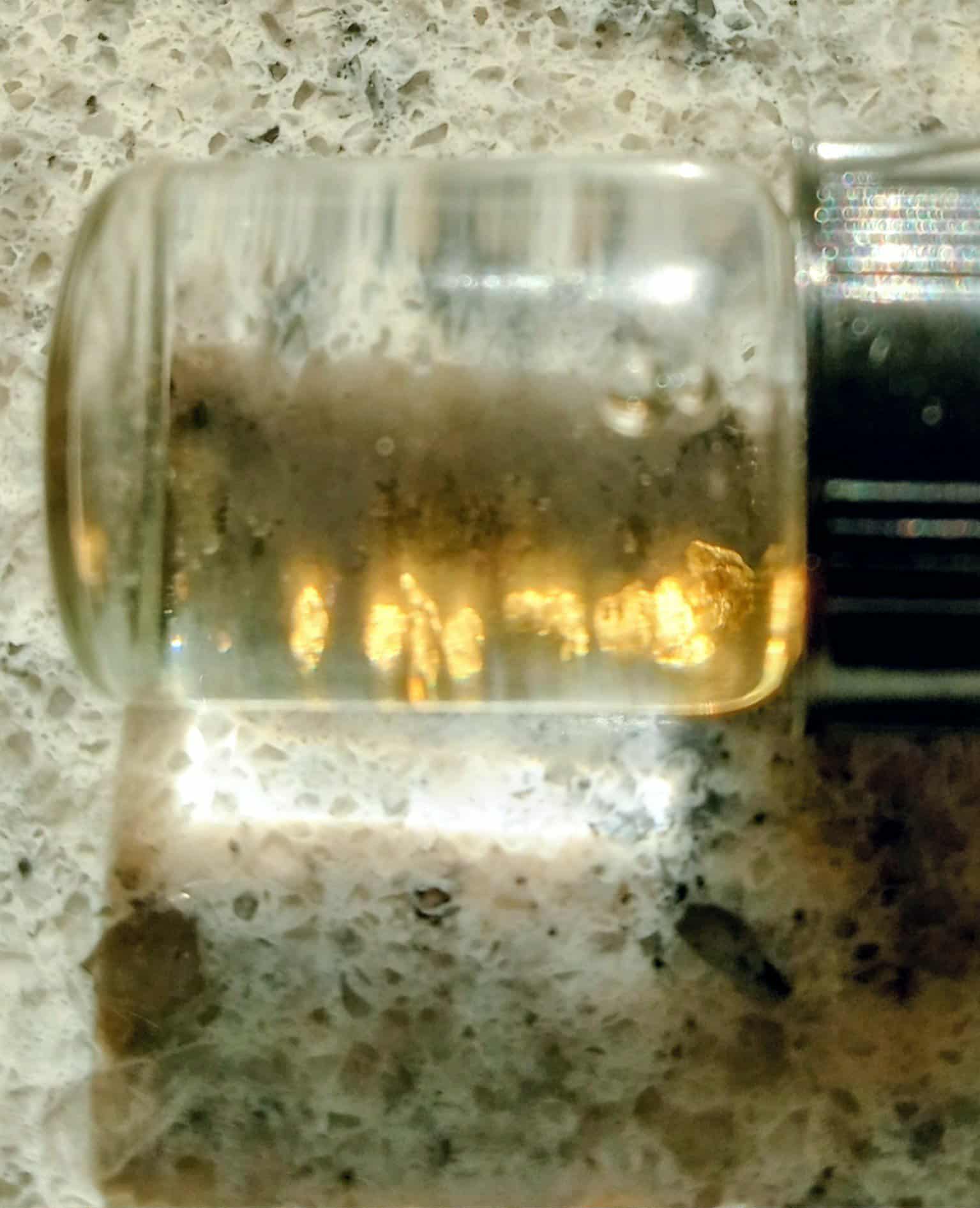
The excursion Tammie and I had chosen at this port of call was panning for gold. A bus waiting near the dock took us and several other people from the cruise to a small river outside of Juneau’s city limits. Our bus driver, Angel, led us down a path to the rocky shore of a swift moving, glacial clear mountain stream. Two tables were set in a clearing a stone throw from the rushing water. One table had a bucket of gravel scooped up from the river shore, pans for us to use, a dish of clean water and small bottles to store the gold flecks we would find. The second table included a trough of water in the center.
Angel took a small scoop of gravel from the bucket and put it in one of the pans, then had us gather around the second table. Scooping up water from the trough, Angel began to move the pan in circles, sloshing out muddy water and stones. She explained, “Gold is heavy. What isn’t gold will spill out when you do this.” Repeatedly, Angel scooped up water and sloshed out stones. Finally, her pan looked empty.
Our Alaskan tour guide from Texas said, “Look closely at the bottom of my pan.” Five small flecks of gold glimmered in the afternoon sunshine. After Angel showed us how to put the gold into a small bottle using a plastic pipette, she said, “Now you go ahead and do what I did.”
I successfully panned three times and found 8 flecks of gold. When Angel said it was time to leave in order to attend an outdoor salmon bake, I wanted to whine, “But I don’t want to leave yet. I want to continue panning for gold!” I’d caught gold fever!
That evening, back on the ship, I told Tammie, “I want to go back to where there’s gold! I really enjoyed panning.”
My daughter admitted, “I wanted to stay there longer, too. It was relaxing to pan for gold, and it was so beautiful along that river!”
With a chuckle I commented, “Too bad we didn’t find nuggets of gold the size of peanuts in a shell! That would have paid for this trip.”
 Life Lines