“Rasp! Rasp! Rasp!” A repetitive sound pulled my attention away from the article I was reading. I glanced around my living room, and then with a frown closed the magazine on my lap. Whatever had made that sound was nearby. The dry scratchy noise made me recall the time my mother scraped a knife across a slice of bread that got too dark in the toaster. After having scraped off the darkly toasted breadcrumbs, she buttered and ate the crisp bread.
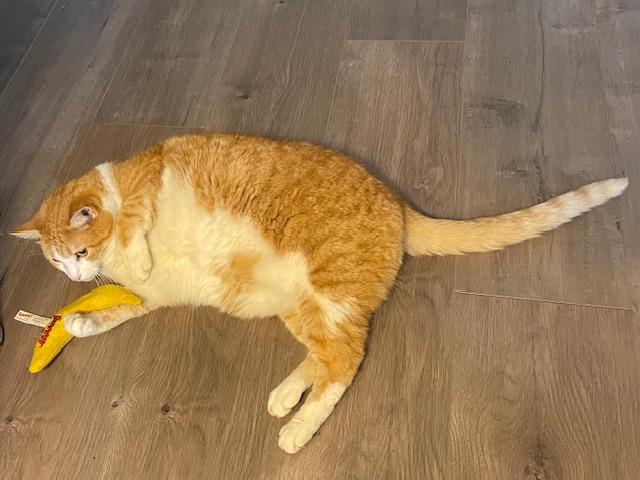
Peeking behind my chair, I saw my cat Jerry playing with a cat-toy that my daughter forgot to take home after one of the visits she’d made with her cats. Looking blissful, Jerry rubbed his face against the old, soiled toy. Stopping mid rub, he began to lick the stained canvas. His moist, textured tongue dragged across the dry canvas. This made the rasping sound that I’d heard earlier. My mouth watered and I shivered convulsively.
The toy had started out many years earlier as a bright yellow, plump banana, made of canvas and stuffed with catnip. Tammie’s cat, Mac, loved this toy and often rolled around on it and licked it, just like Jerry was doing. After being played with this way for years, the yellow color faded, and the middle had turned brown, as if it really was an over ripe fruit. The banana was no longer plump, either.
I should have thrown the old cat toy out, especially since Mac is no longer among the living. But I have trouble getting rid of things that can still be used. I’m more like my mother than I care to admit. Just as my mother had scraped off burnt crumbs, buttered and ate the bread, I’m frugal. Besides, Jerry obviously isn’t repulsed by Mac’s dried saliva!
The appeal of the toy obviously doesn’t rest on its appearance. Catnip must be the draw. Essential oil in catnip plants can turn lazy cats into crazy felines only if the feline has inherited a sensitivity to it. Not all cats are sensitive to catnip’s essential oil, and the trait doesn’t emerge until a cat is three to six months old. Even wild tigers and other large cats can have this trait.
While one half of all cats have no reaction to catnip, the effect it has on the other half varies. Some cats enjoy occasional sniffs of catnip and a chance to roll in it. Others will manage to find a way to get into a closed cupboard to get at a stash. Tammie said her cat Mac was a mean “drunk”. When he was under the influence of too much of this herb, he wasn’t nice to his sister, Carla.
The catnip scent targets “happy” receptors in a cat’s brain. Eating catnip can act as either a sedative, causing a cat to become mellow and zone out or be aggressive and growl. Catnip moods usually last only about ten minutes. A cat won’t have another reaction to catnip until about thirty minutes have passed since their initial dose.
Standing up, I peeked behind the chair again. Jerry rolled onto his back, staring up at me, while purring loudly. Leaning down to rub his soft belly fur, I told him, “It’s nighty-nighttime, Jerry. You need to go to your bed in the entryway.”
Sadie jumped down from her favorite spot in the living room and obediently trotted towards the entryway. I clapped my hands. Jerry looked around, like he was hoping to get out of having to go to bed, then looking like he sighed with resignation, he followed his sister.
As I prepared for bed, I started to think about how much the sound of Jerry licking the dirty banana cat toy bothered me. He wasn’t doing anything bad; it was just something unpleasant to hear. People often do things that are just as hard to listen to. I don’t like the sound of pens being nervously clicked, cracking knuckles, loud food chewing, or gum being constantly snapped and popped. These aren’t bad, or evil things to do, but are the human equivalent to licking a dirty banana.
 Life Lines