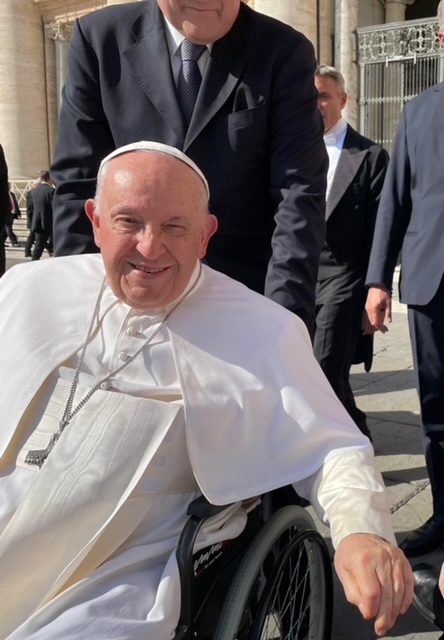
After the death of Pope Francis, I watched news reports on television regarding his funeral, mourning period, and conclave. When the reporters were shown at Vatican City in Rome, they were often standing in a crowded Saint Peter’s Square, describing the mood of the crowd. Seeing the familiar landmarks behind the reporters was like recognizing someone I loved but hadn’t seen for a long time. With a shiver of equal parts of joy and disbelief, I remembered how my daughter and I met and shook hands with Pope Francis at the top of the Basilica steps during a trip we took to Rome in September of 2023.
A deep and abiding respect for the Pope had been instilled in me by my Catholic parents. The Pope is more than just the head of the two-thousand-year-old Universal Church. He is responsible for making sure all the doctrines set by Jesus and entrusted to Peter, the first Pope, never change.
The hot September day Tammie and I met Pope Francis, started with us rushing to Saint Peter’s Square in the early morning hours. When we arrived, there was already a huge line of people that stretched for blocks. Tammie wondered out loud whether the line was for tickets or to get in. Either way, the length of the line filled us with dread since neither of us could bear standing for very long.
We approached a guard stationed by a metal crowd control barrier to ask where to go. He simply moved to one side and motioned us through. We joined a much shorter line to pass through x-ray machines under the colonnade. Once inside Saint Peter’s Square we met colorfully dressed Swiss Guards. Each one we approached, motioned us forward. We got closer and closer to the stairs leading up to the entrance of the Basilica. I said to my daughter, “This can’t be right.” I felt like we were mistakenly being given seats of honor. We ended up sitting on banquet chairs lined up in rows alongside the canopied dais where the Pope would appear. As I looked around at the people sitting around us, I began to understand how we got to be there. This part of the audience consisted entirely of religious and handicapped people. Behind us was a section filled with young men and women dressed in their wedding dresses and tuxedos.
After Pope Francis’ address was repeated in seven different languages, he began to shake hands with the people surrounding the dais. I was in total disbelief! I would get to shake the 266th Pope’s hand! I found his voice to be soft and pleasing to hear and his eyes filled with so much love! After shaking hands with my beaming daughter, Tammie, the Pope affectionately reached up and patted her right cheek.
Now, a year and a half later, I watch the reports from Rome and fondly study the towering, double row of columns found on the left and right sides of Saint Peter’s Basilica and remember standing under them in the shade, thinking that was all the closer we would get to Pope Francis. The two rows of colonnades are like arms opened wide to welcome the crowds who visit. The statues of 140 Saints line the top of the colonnades. Although they look small on the television screen, each statue is over ten feet tall. During my first visit, I remember being surprised to discover that Saint Peter’s Square is not square. Other than a tall obelisk and two fountains, it is a vast, more-or-less round, black cobble-stoned area.
I love Rome: its distinctively tall and skinny umbrella pine trees with their large canopies of foliage, ancient buildings, preserved history, and many fountains. Rome is often called the city built on seven hills, those being the Aventine Hill, Caelian Hill, Capitoline Hill, Esquiline Hill, Palatine Hill, Quirinal Hill and Viminal Hill.
After I turned off the television, I pondered a trivia fact dancing just outside my recollection, “When I visited Jerusalem in Isreal, didn’t the guides say that that city was built on seven hills?” I checked with Mr. Google and discovered that I had remembered correctly. The city of Jerusalem does claim seven hills as well. Then, I wondered, “Is it significant that this Israelite city where the temple was located and the Italian city where the head of the Catholic Church is located, are both located on seven hills?” That question then led me to wonder, “How many cities claim to be built on seven hills?” The answer surprised me. Appropriately, the total is 77.
What is so special about the number, “seven”. The answer is easy to find. Mr. Google informed me that in ancient times “seven” was a universally accepted symbol signifying completion or perfection.
Seven is a number often used in the bible, and it has been estimated that it is mentioned in the good book over 700 times! For example, when Peter asked Jesus, “Lord, how many times shall I forgive my brother or sister who sins against me? Up to 7 times?”
Jesus answered, “I tell you not 7 times, but 77 times.” Forgiveness that many times certainly tells me anyone who can do that has mastered the perfection of sainthood!
The city of Rome was intentionally set back from the Mediterranean shore to protect it from pirates. Being a “Seven Hilled City” meant it was designed to be a place of authority and a center of world power. Rome has long ago outgrown the strict limits of the “Seven Hills” It has sprawled out to embrace other hills in the surrounding area and even hills on the other side of the Tiber River, such as where the Vatican Hill is located. For nostalgic reasons, people still name the city by its original designation: “the City of Seven Hills.”
In the coming days, the conclave of Cardinals will ponder, vote, and name a man to be the successor of Peter. By the time this article appears on my blog site, we may already know which Cardinal is the Catholic Church’s 267th Pope.
Eternal rest grant unto Pope Francis, O Lord
And let perpetual light shine upon him.
May the souls of all the faithful departed
Through the mercy of God, rest in peace.
Amen
 Life Lines