The waitress placed a cup of tea on the table in front of me. Vapor from the hot liquid rose and I leaned forward, appreciatively inhaling the comforting scent of black tea. Carefully guiding the cup close to my lips, I realized the tea was as hot as molten lava and set it back down again on the table.
Two young women walked past and sat down in the booth next to mine. Once they were given the Coke they’d ordered, they began to talk about a party one of them had attended. Party girl eagerly confided, “Amy and DJ got into a big public fight at the party. In front of everyone he went, ‘I saw you flirting just now with Matt! Don’t you realize I’m twice the man he is?’ Amy was like, ‘Oh Yeah? You really think you’re something! But I want you to know, you’re no prize.’” Party girl’s friend concluded, “Geez! That sounds like an old married couple fighting!”
The waitress placed the salad I’d ordered on my table and refilled drinks before returning to the kitchen. As I ate, I thought about the conversation I’d overheard and wondered when people had started to use the word ‘went’ instead of the word ‘said’. This has been going on for several years, and it’s easy to fall into. I’ve caught myself using this word myself. Other words people use instead of ‘said’ are ‘goes’, ‘like’ and ‘all’. For example, he ‘goes’, or, he was ‘all’, or, he was ‘like’.
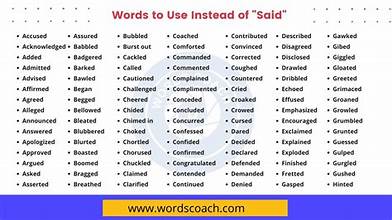
The English language is rich. There are over three hundred words that can be used instead of ‘said’ such as ‘mused’, ‘questioned’, or ‘demanded’. The words ‘went’, ‘goes’, ‘like’ and ‘all’ will probably eventually be added to that list.
Latin is considered a dead language because what the words mean and how they are used doesn’t change. However, Latin is extensively used in scientific, medical, research, and philosophy. Unlike Latin, English is a living, breathing language. It is constantly changing. New words are invented and added each year. Also, keep in mind that many English words have Latin root words, prefixes, and suffixes.
English is one of the hardest languages to learn. Learning to write in English must make students feel like they are entering into Twilight Zone when it comes to spelling. For example, the ‘gh’ in the word enough, is pronounced like an ‘f’. The ‘o’ in women is pronounced as a short “I”. In the word ignition, the ‘ti’ sounds like, sh’. Also, some words have silent letters, like knife and sword. However, the ‘k’ and ‘w’ are not silent in other words, such as in king and wet. Some weird English spellings are remnants from the Middle Ages, while others are holdovers from the invention of the printing press.
Like a grabby toddler, English has snatched words from many other languages to use but doesn’t always change the foreign spelling. Think of the words, faux and a buffet (as related to food). Despite these alphabetical roadblocks, it is estimated that one and a half billion people in this world speak English.
I’ll admit, I am a bit touchy about the word ‘said’. As a writer, I have been told not to use the word ‘said’ over and over in a conversation dense article. On the flip side of the rule to not overuse the word ‘said’, is the rule to continue using ‘said’ at times. It is a linguistic tight-rope balance to keep in mind all these do’s and don’ts.
English is messy, like a pair of loose rain boots, slopping around on our feet. It doesn’t always look good. It may even make us feel uncomfortable at times. And it’s often annoying, especially when I need to look up the spelling of a word. Recently, I got all, “Words like hors d’oevres are so stupid! How am I supposed to find it in the dictionary if I don’t know how to spell it?”
 Life Lines