I waded through enthusiastically growing plants, checking on their progress. The amount that plants manage to grow in 30 to 40 days after the seeds and nursery babies are put into the ground never fails to impress me. Beautiful, large leaves umbrellaed over the zucchini and melons, tomato plants, once skinny and delicate looking now looked like happy, healthy, large balls of green leaves and yellow blossoms. Even the slow-to-start carrots showed up bushy and vigorous.
There were few, if any, weeds around the plants and none in the walkway since it was still so early in the summer. When my eyes spotted a row of stubbles instead of green bean plants, I came to a stop and glanced around. Along the empty row I spotted rabbit pellets. “Those darn rabbits!” I huffed angerly. “There’s so much for them to eat outside of the garden this time of the year, why do they have to come in here to eat?”
My garden building was over twenty years old. The structure was showing its age: wooden boards were rotted; a plastic panel was missing from one end, and the plastic skin that covered the whole building was full of holes. Until it was repaired, there was no way I could block the rabbits and deer from entering the garden to graze. There were several places where the hooves of a deer had punctured holes in the plastic mulch sheets. Where the rabbits munched on low-growing plants, deer nibble on taller vegetables. The peas and sunflowers didn’t survive their midnight snacks, either.
At the end of July, a work crew came to replace rotting wood support boards on the hoop building garden and swapped its leaking plastic covering with fresh material. Before they did the work, I weeded the walkway. After they left, I went to work spreading woodchips on the perimeter of the garden. The rabbits continued to visit, but since the peas, beans and sunflowers were gone, they limited themselves to just eating lower leaves.
Each growing season, I learn something new. Some years I have discovered that certain plants do better, planted on one side of my garden, than the other. I experiment with supports to hold up the foliage. Trying to grow new varieties of vegetables makes harvesting interesting.
I sometimes use seeds from last year’s plants, especially when I enjoy the vegetables. Last year my daughter Niki gave me a delicata squash from her garden. I loved its tender, eatable skin and its smooth, silky texture, so I saved some seeds from it.
This spring I planted four different types of vine plants. I looked forward to eating the fruits of my labor. The plants were butternut squash, delicata squash, cantaloupe, and burpless cucumbers.
Burpless cucumbers are an early crop, and they were delicious, but overall, didn’t do as well as they did last year. I think they were unhappy that I planted them next to the horseradish.
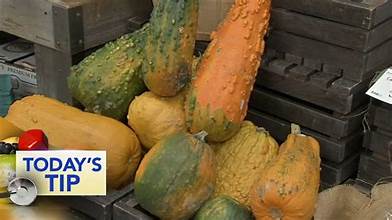
In late August, I did another inspection of the vine plants, hoping to be able to pick some gourds. I discovered that the melon and butternut squash plants did very poorly. They appeared to be crowded out by the overly vigorous delicata vines. The delicata squash gourds didn’t look like they were supposed to look. They were too big, and had lumpy, yellowish/orange skin with green stripes.
I picked one of the mutant delicata gourds to eat. It was impossible to cut it open. A chainsaw seemed to be needed for that job. Figuring that it would soften when baked, I put it into the oven just as it came from the garden. After baking for more than an hour, I still had a hard time cutting it open. A butcher knife and a hammer finally cracked the shell. The flesh of the gourd was a huge disappointment. It had the appearance and texture of spaghetti squash. Instead of the slightly sweet, smooth texture I was expecting, it tasted bland.
Wondering what went wrong, I went to my computer to Google research the problem and then shared what I learned with my daughter, Niki. “Did you know that certain types of squash can interbreed? This isn’t a problem unless a person saves the seeds and uses them the following season. To prevent cross pollination, the different varieties of squash need to be planted at least half a mile apart to prevent accidental breeding.” Then, I asked, “By any chance, did you raise spaghetti squash in your garden last summer? Delicata and spaghetti squash can cross pollinate.”
My daughter answered, “Yes, I did.”
The horticultural mystery was solved!
A cold, frosty night has recently damaged most of my garden plants, so now I need to focus on putting my garden to bed for the winter. I can now file my yearly Garden Report Card for the 2024 growing season. My garden and I both deserve an A+ for having learned how cross pollination can mess with a second-year harvest.
 Life Lines