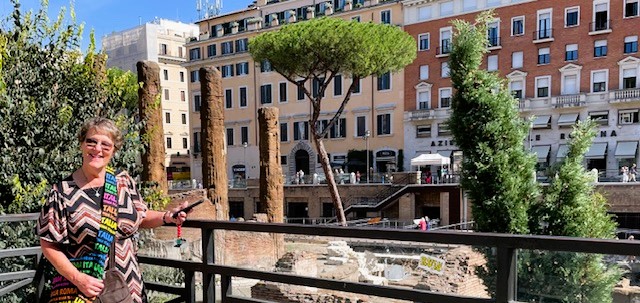
I looked forward to seeing the spot where Brutus killed Julius Caesar, but every time my daughter Tammie and I talked about going there, she kept talking about, “Santuario dei Gatti di Torre Argentina” which could be found at the same location. “It’s a cat sanctuary,” she excitedly informed me. I had the distinct impression she was more interested in seeing the cats than seeing the famous Emperor’s historical murder site. The incongruity of the two sites sharing the same space was lost on me.
My interest focused more on the 2,067-year-old crime scene. Not knowing what it would look like all these years later, I wondered with a chuckle, “Would there be a large ‘X’ marking the spot where it happened, and yellow tape cordoning off the area?”
When we arrived at Largo di Torre Argentina (Tower Square), the place managed to surprise me. It was a large open space the size of a city block, surrounded on all four sides by tall, solid buildings, some of which were ornately decorated. Within the walled-in block there were many ancient pillars and paving stones below street level, which dated back to the Curia of Pompey, the Roman senate building, the very spot where Caesar is believed to have been assassinated. Also contained within that block were the remains of four Roman temples built there in the centuries following the crime.
In 1503, a Papal Master of Ceremonies, who came from Strasbourg and known as “Argentinus” built a palace with a tower on top of where the senate buildings and temples had once stood and is the reason why that city block is named, “Torre Argentina”.
During the demolition of Torre Argentina in 1927, work crews unearthed the colossal head and arms of a marble statue. Archaeological investigation brought to light the historical significance of that spot in Rome. Then, as has happened in so many other places in the city, the site was preserved.
Tammie and I bought tickets to enter the walkways among the archaeological excavation. Information stations posted along the walk explained the historical significance of what was found in those spots. There was no breeze in this pit. The sun felt like it was shining down on us through a magnifying glass. Tammie figured out a way for us to be more comfortable. She took pictures of each information stand and she read them to me while we stood under a small, shaded shelter. Eying the remains of the senate building, I asked, “When Brutus stabbed Caesar, do you really think Caesar questioned, ‘Et tu, Brute?’”
Shrugging, Tammie guessed, “Probably. Brutus was not only his friend, but the son of a beloved mistress. Caesar was confident Brutus wouldn’t betray him, but Caius Cassius Longinus and many other senators had managed to convince Brutus that by killing Caesar, who had made himself dictator for life, he would be preserving the familiar Roman way of life.”
I mused, “Ceasar was so confident, that the repeated warnings, ‘Beware the Ides of March’ from soothsayer, Spurinna, didn’t faze him. That’s surprising because March 15th was a significant date in his culture, and Romans at the time were very superstitious.”
Right from the start of the archeological dig, stray cats flocked to the temple ruins where they sheltered among the pillars and were fed by locals. They took up residence in the work sheds. The four temples located on the Largo di Torre Argentina site are labeled with the first four letters of the alphabet. Portions of Temple D is under a busy street alongside the square. In this corner of the dig, we found the Torre Argentina Cat Sanctuary.
In 1993, Roman was home to 500,000 feral cats. That year concerned citizens opened the shelter to care for the cats. Thirty years later, the number of feral cats in Rome is down to about 90,000. The shelter is a no-kill shelter. Strays from all over the city are spayed, neutered, and given their shots. Cat lovers adopt cats who are tame, but all the old, sick, unadoptable cats live at the shelter and are cared for by volunteers.
The shelter workers allowed my daughter and I to enter the under-the-street room to visit the unadoptable cats. Living as a homeless cat is extremely dangerous, so many of these felines were missing eyes, limbs or had paralysis from past injuries. Others were born with congenital defects that prevented them from successfully living wild but were not suffering. Happy to be fed and cared for, the unmistakable vibration of trollies and vehicles passing overhead didn’t bother these content pussycats.
Tammie and I found a place to wash our hands after we left the shelter. I complained, “I feel cooked by the sun and hungry. We should find a place to cool off and eat before we take the bus back to our apartment.”
My daughter answered with enthusiasm, “Good idea. Maybe we can also do a little shopping in the stores along the square.” Later, as we sat in the shade, drinking Aperol Spritzes and eating slices of pizza, Tammie asked, “What did you think of today?”
I mused, “I enjoyed our visit. The place is like a keyhole that allowed us to peek into the past. When we first arrived, I thought about it as a murder investigation scene. A crime did take place here, but there was never an investigation. Brutus openly admitted he did it. I read that he even spoke publicly defending what he had done.”
Tammie nodded and concluded “Many people wanted Caesar dead, but when Brutus killed him, he lost his political backing, and instead of returning Roman society to what had been before Caesar, there was turmoil. Brutus ended up killing himself two years later when he was cornered in battle.”
 Life Lines