The outskirts of Rome fell behind us as our bus merged onto a busy highway north of the city. I leaned forward to peer out of the window, eager to see what the Italian countryside looked like. For the last seven days, my daughter Tammie and I had been exploring the city of Rome. Today we were leaving ‘The City of Seven Hills’ in the Lazio region, to visit Orvieto and Assisi in the Umbria region and to stop for lunch in the Tuscany region.
Rows of pale green olive trees marching alongside the road flashed by. Vineyards with vines pruned to increase production, dusty tobacco fields, hay fields and harvested grain fields dotted the countryside. Clumps of extremely tall pampas grass, and an Italian high speed train shooting through the countryside fascinated Tammie and me. Driveways to farmhouses that were lined with Italian balloon pine trees or palms made us want to stop to investigate. Mountainous ridges formed our horizon to the left and right. The highway appeared to be on a flat plain between them.
The medieval town of Orvieto was our first stop. Our bus drove uphill as far as the road went. Getting off the bus, we entered a vehicle called a funicular, which is a cable railway system used on steep slopes. Funicular systems have two counterbalanced carriages called cars or trains. They are permanently attached to both ends of a haulage cable, which results in the two cars moving in opposite directions at the same time. As one goes down, the other goes up. The unusual name, funicular, is from the Latin word for rope (cable).
Getting off the funicular, we hadn’t reached the city of Orvieto, yet. There were still two flights of stairs to climb. I wished the funicular had continued up this slope. As I ascended, I counted each step, and the grand total was 48. Our guide explained that medieval towns were built on hilltops because enemies were unable to launch surprise attacks on them and the towns were more easily able to defend themselves.
The jewel of Orvieto is its large cathedral with three gables. The construction of it spanned a period of three centuries. Large side chapels flank the front of the church. One chapel is devoted to the evidence of a Eucharistic miracle which took place in a nearby town in 1263. In the chapel across from it, frescoes painted by Luca Signorelli adorn the ceiling and walls. The frescoes depict his vision of how the second coming of Our Lord will look. There were two statues in the church that I especially liked. One was a pieta. Unlike the pieta by Michelangelo which only shows Mary and Jesus, it showed the cross Jesus had been taken down from, a ladder and Nicodemus. The other statue I liked was of a very fit-appearing warrior, Saint Michael the Archangel.
A large courtyard surrounded the cathedral and small souvenir shops lined small, narrow streets leading away from the cathedral towards a tall clock tower. Orvieto is famous for its pottery. In one well-stocked ceramic shop I bought a painted dish to give my daughter, Niki for Christmas. Its brightly colored countryside and sunflowers made me think of her.
Our visit to Orvieto ended too soon. On our way to lunch we passed Italy’s fourth largest body of water, Lake Trasimeno. Our guide said the water levels were low because it hadn’t rained for four months. Our meal was at a farm in the middle of the Tuscan countryside. Years before, the farmer had built guest houses in his farmyard to accommodate tourists so that he could earn extra income. Then, because these guests wanted food and drinks, he built a small bar and dining room.
After lunch we set off for Assisi. Like all the other towns in the area, it is perched high above the countryside around it. Fortunately, our bus was able to drive directly to a parking lot next to one of its churches. A short hike brought us to a courtyard with a walled vantage point. Looking out at the surrounding countryside, we saw a colorful patchwork of farm fields, and other hilltop towns with red-tiled roofs. A shimmer of heat waves danced above everything as the fall sunshine baked the already dry countryside.
Small souvenir shops lined each street, their treasures spilled out on tables for display. I wanted to stop and look at statues, and ceramic plaques, but I had to keep up with the tour.
In a central plaza, an artist had rendered a beautiful chalk drawing of Jesus. Considering his crude tools, chalk, and rough pavement for his canvas, it was well executed. The man who created the picture sat nearby. I was so impressed by his talent; I dropped Euro coins in his cup. He nodded in appreciation.
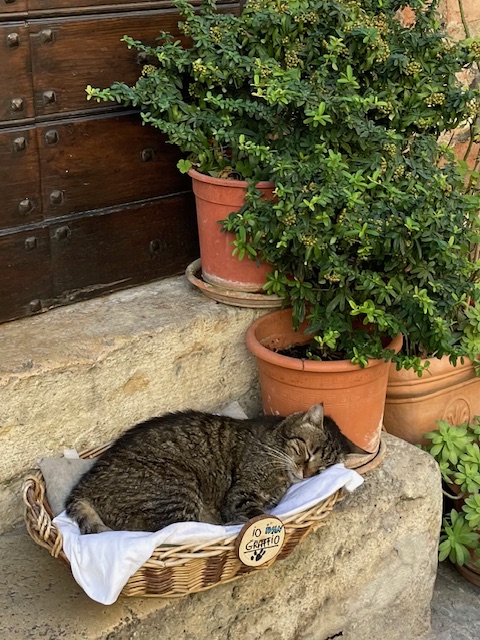
Outside one store was a basket with a large tabby cat sound asleep in it. Tammie said a laugh, “Everyone must ask about the cat’s name. The sign says, ‘the cat’s name is Ivan.”
Stopping next to a fountain to rest, I commented, “Every single cobblestone street in Assisi seems to be at 45-degree angles. We either must slowly, laboriously plug uphill, or brace ourselves like mountain goats to keep from falling while going down!”
Tammie used her scarf to mop sweat from her face and agreed, “I personally find going downhill hurts my knees more than going uphill.”
It had been dark when we took a taxi to the bus terminal that morning, and it was dark when the bus returned us to Rome. The line of people waiting for taxicabs stretched a city block long. Near the front of the line was a woman who had been on the tour with us and had eaten lunch at our table. By a wonderful coincidence, she was taking a taxi to the same Rome neighborhood as our apartment, and generously offered to share the ride.
We had spent the day reaching lofty new heights in beautiful Italian hilltop towns, but the human kindness this new friend showed my daughter and me late that day reached even higher heights and was most appreciated.
 Life Lines