
Leaning against a bridge rail, I squinted up the Tiber River towards Saint Peter’s Basilica. It was drenched in early August morning sunshine practically glowing in contrast to the blue sky and Rome’s iconic, green, balloon pine trees. Along the river, halfway between the bridge where I stood, and the Vatican, was a large cylindrical stone building. Pointing, I questioned, “What is that big, round, stone building to our right?”
The pilgrimage guide standing next to me offhandedly commented, “Oh, that’s Castel Sant’ Angelo. There’s a passageway between it and the Vatican. When barbarians sacked Rome, it was used as an escape route for Popes. We won’t be visiting it on this pilgrimage.” Then, looking around he called out to my fellow pilgrims, “Let’s cross the bridge. The Pantheon isn’t much further.”
A Pope needing to escape from frenzied, pillaging Vandals intrigued me. I loved the idea of the Vatican having a secret passageway to the safety of a castle fortress! Unfortunately, my curiosity wasn’t satisfied during that trip.
Ten years later, my daughter Tammie asked me if I would travel to Rome with her. When I said yes, she ordered, “Tell me what you want to see there, and I’ll make it happen.”
My answer was, “I want to see everything, and this time that includes what’s inside Castel Sant’ Angelo.”
Tammie made good on her promise. On our third day in Italy, we visited the fortress along the Tiber River. In English it is known as the Castle of the Holy Angel. The history of this site dates to 135 A D, when the Roman Emperor Hadrian built a mausoleum there for himself.
Hadrian built a 135-meter bridge over the Tiber River which flows alongside his monument. Initially, the bridge was called Aelian Bridge or Hadrian’s Bridge. It connected the city to his mausoleum. Christians used it as a passageway to Saint Peter’s Basilica.
The massive Hadrian Mausoleum was converted to a fortress by Emperor Aurelian in the 3rd century. It became an important strategic point for Roman warfare and was at one time the tallest building in the city of Rome.
The Mausoleum was renamed Castel Sant’ Angelo in the 6th century after Pope Gregory had a vision of Saint Michael the Archangel above it, sheathing his sword, signifying the end of the plague in 590 A.D.
During the 7th century, statues of angels, most notably Saint Michael the Archangel, were erected on Hadrian’s bridge. The bridge was then renamed the Ponte Sant’ Angelo, Bridge of the Holy Angel. Those original statues have been lost. The ten statues on the bridge today are what are left of the 20 angels created by Bernini in 1668.
In 1277, Pope Nicholas III, who lived at the fortress, had an elevated corridor built to connect the Vatican to the castle. It was called the Passetto di Borgo. It is 800 meters long and has served as an escape route for Pope Alexander VI when King Charles VIII of France invaded Rome in 1494, and for Pope Clement VII during the Sack of Rome in 1527.
During the Renaissance, the castle was completely transformed under Cardinal della Rovere, later known as Pope Julius II, who preferred to reside at there, rather than in the Vatican Palace.
Victor Emmanuel III, the last Italian monarch who served until 1947, inaugurated the castle as a museum where visitors can view works of art and visit the Papal Apartments that were authentically restored to the time-period they were used.
The day my daughter and I visited the Castle of the Holy Angel, Italy was sweltering under a hot, late September sun. We leaned against stone window openings to enjoy occasional breezes and to look down at the slow-moving, opaque, blue-green water of the Tiber River.
On the upper floors of the rotund building, we saw frescos, statues, framed canvases, and apartment rooms that Popes had once lived in. As we followed the curving corridor on the rooftop next to the high, crenellated parapet, we were surprised to come upon a grapevine-canopied café. Tammie and I sat down at a small table next to a large, open window that gave us a lovely view of Saint Peter’s Basilica.
As we sipped Aperol Spritzes and admired the scenery, I suddenly realized we were right above the Passetto di Borgo, the very thing about the castle that had captured my imagination ten years earlier!
Touching Tammie’s glass with the side of mine, I said with a content smile, “You said you would get me into the Castle of the Holy Angel, and you did! Thank you.”
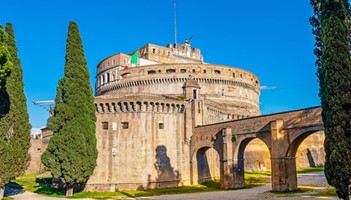
This view of Castel Sant’ Angelo shows where the Passetto di Borgo, the Pope’s escape route to the fortress, enters the castle.
 Life Lines
Interesting article. Nice picture of you, too. We enjoy your writing & have a Blessed Christmas.
thank you!