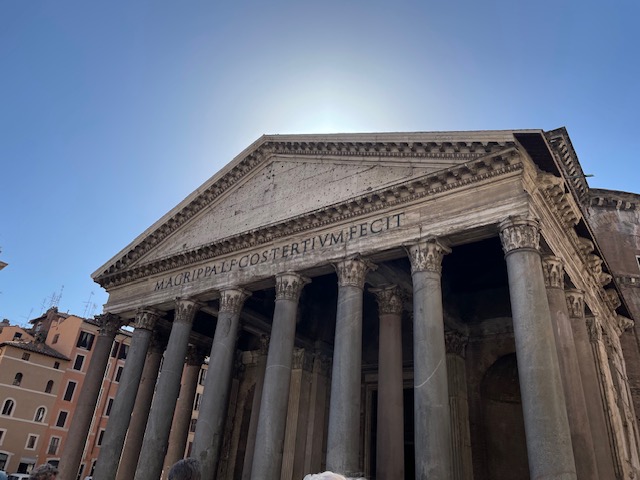
Italian ambulance sirens make a peculiar wailing sound. One raced past our Airbnb apartment as I awoke that Tuesday morning. To my surprise, my daughter Tammie was already awake, uploading and labeling pictures she’d taken the day before. Slipping out of bed, I brushed my teeth and washed my face before going to the kitchen to fry eggs for our breakfast.
Tammie came into the kitchen and sat down at the table. Pouring two cups of black tea, I commented, “For breakfast we only can have one fried egg apiece, a small wedge of spicy sausage and fresh grapes,” My daughter nodded her approval. Our shopping trip the day before hadn’t turned out the way we had planned. The half dozen eggs we purchased at a market fell on the sidewalk. Four of the eggs broke. Spicy sausage turned out to be so full of red pepper that eating anything more than a bite or two burned our mouths.
Placing breakfast on the table, I sat down and questioned, “What does my tour guide have on schedule for today?”
My daughter thanked me for making breakfast and announced, “I’ve arranged for us to join a tour of the Pantheon. We’ll get on a city bus in about half an hour and it’ll take us within a few blocks of where we want to go.”
A cloudless sky and a bright sun greeted us as we left the apartment. We didn’t have to wait long for the bus, but I felt fortunate to stand under the shade of a small tree. All the seats on the bus were taken, but when we boarded, two people stood up and offered their seats to us. Surprised, grateful, and slightly embarrassed, I sat down.
The two blocks we walked to get to the Pantheon resembled a medieval movie set with cobble stone streets, fountains, tiny shops, and businesses. Sunshine bounced off the buildings and cobble stone and made us feel like we were in an oven. We tried walking only on the shady side of the streets. Unfortunately, other tourists had the same idea, making that area crowded.
I was happy when the tour started. Not only did it take us out of the hot sun, but also it meant that we didn’t have to stand in the long line like other tourists who hadn’t paid for a tour. Wearing small transmitters around our necks and using earbuds, we entered the portico, a long, narrow open area on the north side of the building. Sixteen 40-foot-tall columns made of Egyptian granite surrounded it. The word “pantheon” we were told, is from an ancient Greek word meaning “all gods,” but may not have been used to refer to this building until modern times.
The current Pantheon was built at the command of Emperor Hadrian and was dedicated in 126 AD. It replaced a temple at that location commissioned by Marcus Agrippa during the reign of Augustus which was destroyed in the great 80 AD fire of Rome. Both temples had statues and shrines to the many Roman gods.
Constantine, who ruled 306 to 337, became the first Roman Emperor to convert to Christianity after living as a pagan for most of his life. With his conversion, the persecution of Christians ended for a time, allowing Christianity to flourish in the Roman culture. In 609 AD the Pantheon became a Christian church, dedicated to Mary, mother of Jesus and all the martyrs. Everything pagan was removed and replaced with Christian altars and statues. It is the best preserved ancient Roman building because of its continuous use. Mass is held there weekly, on Holy Days of Obligation and for occasional weddings.
There are no windows in the Pantheon, but there is a great opening in the center of the dome called an oculus. The dome is 142 feet high and the inside diameter of the oculus also measures 142 feet. Almost 2,000 years have passed since the dome was built, but it still holds the world record for the largest unreinforced concrete dome!
The oculus in the dome and the entryway are the only natural sources of light. As the day passes, sunlight from the oculus moves from one side of the marble floor to the other side, in a reverse sundial effect, measuring time with light rather than by shadow. During storms, a drainage system below the floor easily handles rain falling through the oculus. Our guide said, “No matter how much it rains, there’s never a puddle of water.”
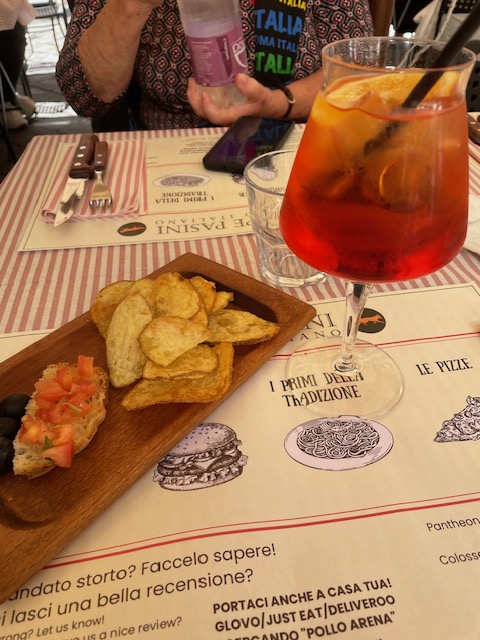
After our tour was over, Tammie and I slowly headed back toward the bus stop. All along the cobblestone streets were gift shops, gelato stores, and sidewalk restaurants. As we walked past a picturesque sidewalk café, we saw a sign that proclaimed, “Aperol Spritz and chips for only 5 Euro.”
Eying an umbrella shaded table, Tammie announced, “I’m going to order an Aperol Spritz!” I gratefully sat down across from her in the shade. Looking at the menu, she pointed out, “Look, they have calamari!” I loved the calamari I had in Spain several years ago, so we ordered some.
The Aperol Spritz came in a large, stemmed, balloon glass and was a vivid orange in color. A slice of orange and a ridiculously long drinking straw garnished the icy drink. I glanced around and noticed that Aperol spritzes were a very popular drink at the other tables. Pulling Tammie’s drink toward me, I took one sip and understood why. It tasted so good and was the perfect way to refresh our spirits on a hot, September afternoon in Rome, Italy!
Aperol Spritz
In 1919, after seven years of experimentation, Luigi and Silvio Barbieri of Padua, Italy created a liquor they called Aperol. Its alcohol content was only 11%. The Barbieri company immediately began producing Aperol, but it wasn’t until after World War II that the drink become wildly popular.
Aperol is an aperitivo, an appetite-whetting beverage because gentian, and cinchona, ingredients used in its production, are said to stimulate appetite. Rhubarb and a secret combination of herbs are also used to make this bright orange alcohol.
The popular Aperol spritz is made by combining three parts of Prosecco (a sparkling white wine), two parts Aperol and one ounce of soda water. It is served over ice in a stemmed balloon glass and garnished with a slice of orange and a tall straw.
 Life Lines